EV Charger Parts: Machined Contact Pins, Overmolded Connectors and Station Housings
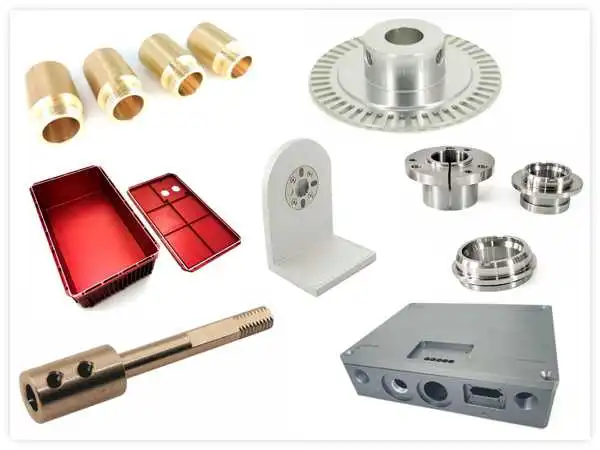
Davantech turns the contact pins for EV charging connectors and overmolds them into plugs and cables. For charging stations we make the housing parts, from machined extrusions and sheet metal to machined brackets, and assemble complete units. All in one ISO 9001:2015 certified factory in Dongguan, China, built to your drawings.
Machined and Molded Parts for EV Chargers
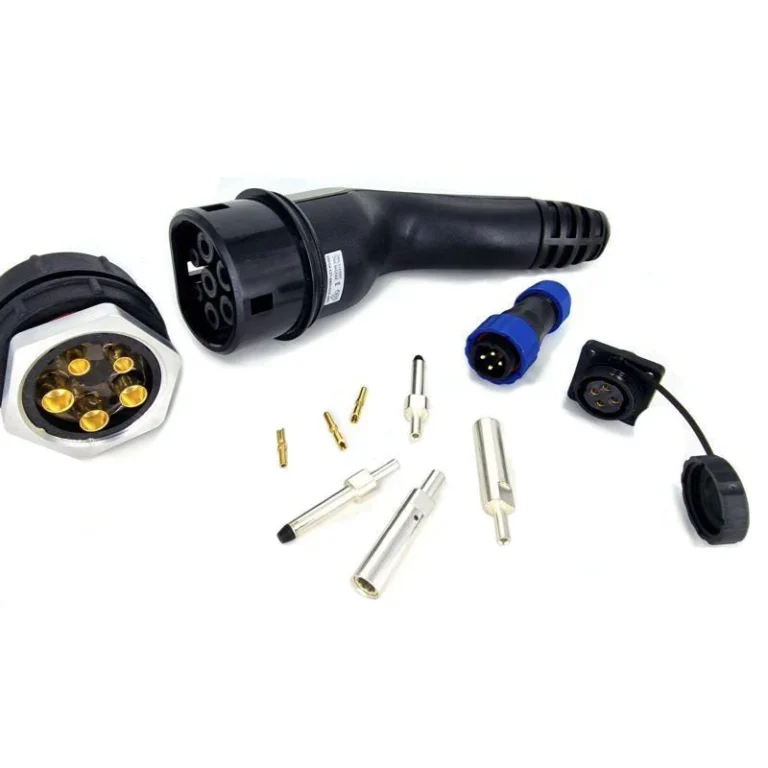
In an EV charging connector, the contact pins are the machined parts; the rest of the connector is molded around them. The charging station is a different story: its housing is built from extruded profiles, sheet metal and machined parts. We make both, so your parts come from one supplier with one quality system. See all our CNC machining services.

- Male pins and female sockets
- Power, earth and signal contacts
- Crimp sleeves and threaded inserts

- Machined extruded housing profiles
- Sheet metal covers and panels
- Machined brackets, hinges and bases

- Pins insert molded in PA66 or PBT
- TPE, TPU or silicone overmolds
- Sealed IP67 and IP68 designs
- Cable cutting, stripping and crimping in-house
How Precision Turned EV Charging Pins Are Made
Charging pins carry tens to hundreds of amps through a small contact area. A diameter that is a few hundredths too small, a burr in a socket slot or uneven plating raises contact resistance, and resistance turns into heat. That is why charging pins are turned on CNC lathes from bar stock and measured feature by feature. More on the process on our brass CNC machining page.
Materials for EV charging pins
| Material | Conductivity | Machinability | Typical use |
|---|---|---|---|
| Brass CuZn39Pb3 / CW614N | About 26% IACS | Excellent | Signal pins, low and medium current, cost-effective |
| Tellurium copper (C14500) | About 90% IACS | Good | High-current power pins and sockets |
| Copper ETP (C11000) | About 100% IACS | Difficult, gummy | Busbars and simple shapes |
| Silver plating | Lowest contact resistance, the usual choice for high-current power contacts | ||
| Nickel plating | Wear and corrosion barrier, often under silver or on signal pins | ||
Conductivity values are typical for the alloy. The right choice depends on current, mating cycles and the connector standard; we follow the material and plating on your drawing.
Overmolded EV Connectors and Charging Cables
Overmolding bonds a layer of TPE, TPU or silicone over the cable, the contact carrier and the back of the connector. It replaces glue and separate seals, adds strain relief where the cable bends most and makes the handle part of the seal.
For EV charging cables TPU is the usual choice: it resists abrasion, oil and UV and stays flexible in the cold. TPE costs less for indoor or low-stress parts, and silicone handles the highest temperatures. Compare them in TPE vs TPU for overmolding.
We cut, strip and crimp cables in-house, insert mold the turned pins into the rigid contact carrier, then overmold and test. Sealed designs leave with a tested seal; see IP65 vs IP67 vs IP68 for what each rating means, and a customer example in our overmolded EV charging cables project.

From Loose Parts to Assembled Chargers
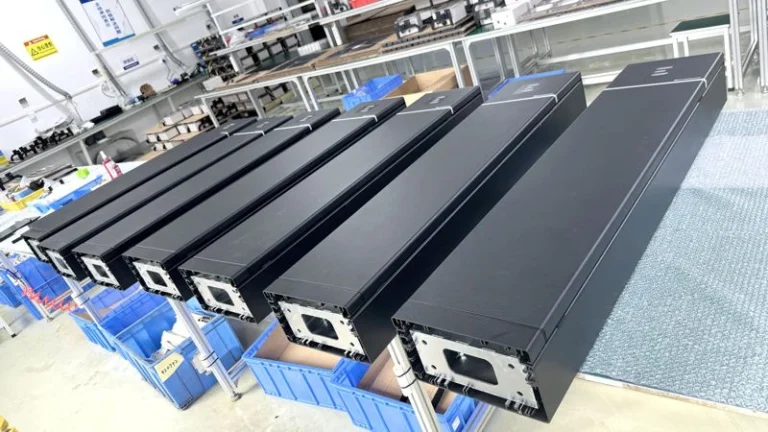
A charging station housing combines extruded aluminum profiles, sheet metal panels and machined parts such as brackets, hinges and mounting bases. We make these parts, have them powder coated or anodized, and assemble the complete unit: housing, cable glands, internal wiring, the charging cable with its connector, and PCBs, which we source and have assembled through our PCB partners. Every unit is tested to your test plan and packed for export.
The photos show charging station housings during assembly in our Dongguan factory. Read more about our product assembly in China or how we approach custom connector manufacturing.
What to Send for an EV Parts Quote
- 3D model and drawing: a STEP file plus a 2D drawing with tolerances, material and plating.
- Quantities: batch size and expected annual volume, so we can choose the right tooling.
- Electrical data: connector standard and current rating for parts that carry current.
- Cable specification: cross-section, number of cores, jacket material and length.
- Sealing: the IP rating you need and how it should be tested.
- Documents: material documentation, RoHS and REACH declarations and measurement reports you need with delivery.
Product certification such as CE, UL or TÜV is carried out on your finished charger, under your name. Tell us which material documents, declarations and measurement reports your certification file needs; we confirm the agreed scope before ordering. For a first order, our guide to ordering CNC parts from China walks through the steps.
EV Charger Parts Questions
Which parts of an EV charger are machined?
Can you machine EV charging pins to my drawing?
Which material is best for EV charging pins?
Do you make complete EV charging connectors?
Which overmold material is used for EV charging cables?
Are your EV charger parts certified?
What quantities and lead times do you work with?
Send your STEP file, drawing and annual volume. You get a quote with DFM comments within 24 to 48 hours, from engineers who make pins, housings and overmolded cables every day.