
Injection Molding of PVDF
PVDF parts, molded and machined to spec
PVDF (polyvinylidene fluoride, sold under names like Kynar, Solef and Hylar) is a high-performance
fluoropolymer prized for outstanding chemical resistance, service temperatures up to around 150°C
and high purity. That makes it a go-to plastic for chemical processing, semiconductor and water
treatment parts, the jobs where cheaper plastics fail.
Davantech supplies PVDF parts two ways: injection molding for higher volumes, and CNC machining for
prototypes and low runs. We handle the tooling, the molding and the machining, and provide material
certificates on request, from our base in Dongguan, China with European engineering management. Send
a drawing and a target volume and we will tell you which route is cheaper for your part.
This page covers what PVDF is, its properties, how it is injection molded, when to machine it instead,
and where it is used. See our wider injection molding in China
service, the full list of CNC materials we machine, and our
CNC machining service.

PVDF properties
Typical properties for standard PVDF. Grades vary, so treat these as a guide and ask for the data
sheet of the exact grade when it matters.
| Property | Typical value |
|---|---|
| Material type | Semi-crystalline fluoropolymer |
| Max continuous service temp | approx. 150 °C |
| Melting point | approx. 170 to 178 °C |
| Density | approx. 1.78 g/cm³ |
| Tensile strength | approx. 40 to 55 MPa |
| Water absorption | very low, approx. 0.04% |
| Flammability rating | UL 94 V-0 |
| Chemical resistance | Excellent |
Note: PVDF keeps its strength and chemical resistance across a wide temperature range, and its very low water absorption means molded and machined parts stay dimensionally stable in service.
What makes PVDF worth specifying
PVDF costs more than commodity plastics, so it earns its place where a part has to survive aggressive chemicals, heat or years outdoors. Here is what you get for it.
- Outstanding chemical resistanceStands up to acids, bases, solvents and halogens, which is why it dominates chemical and semiconductor fluid handling.
- High-temperature serviceWorks continuously to around 150°C without losing strength, well beyond commodity plastics.
- Inherently flame retardantUL 94 V-0, self-extinguishing with low smoke, so it suits electrical and safety-critical parts without additives.
- High purityLow extractables and high cleanliness make it a fit for ultrapure, food and pharma-grade fluid systems.
- Weather and UV resistantHolds up outdoors and under UV for years, a reason it is used for coatings and outdoor components.
- Strong and dimensionally stableGood mechanical strength and stiffness for a plastic, with very low moisture absorption so parts stay to size.
Choosing the right PVDF grade
PVDF is not a single material. The grade sets the temperature range, flexibility, purity and price, so
it is worth matching to the job before tooling or cutting. These are the families you will meet.
- Homopolymer PVDF: the standard grade, with the highest stiffness, strength, temperature and chemical resistance. The default for chemical processing and semiconductor parts.
- Copolymer PVDF (PVDF-HFP): more flexible, with better impact and stress-crack resistance and easier processing, at a slightly lower maximum service temperature.
- Glass-filled and reinforced grades: added stiffness and dimensional stability for structural parts that must hold shape under load.
- High-purity and semiconductor grades: ultra-clean resin with very low extractables for ultrapure fluid handling and clean-media parts.
- Pigmented and UV grades: colored or UV-stabilized for outdoor use and safety marking.
Tell us the chemicals, temperature and purity your part has to survive and we will confirm the grade,
then mold or machine it to your drawing with a material certificate on request.

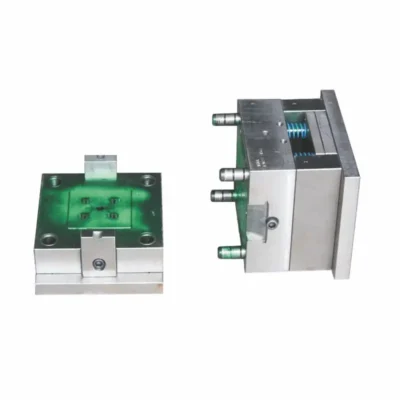
PVDF molds like other thermoplastics, but at higher temperatures and with tooling built to suit it.
Molds, cavities and what drives the timeline
PVDF is more demanding to mold than commodity plastics. It runs at a high melt temperature, wants
corrosion-resistant tooling because it can release trace hydrogen fluoride if overheated, and it
shrinks more than materials like ABS, so the mold is cut to suit the grade and part. Get the tool and
the process window right and PVDF molds cleanly and repeatably.
- Mold typesingle or multi-cavity steel tooling
- Surfacescorrosion-resistant, suited to PVDF
- Family moldsrelated parts in one tool where it saves cost
- Volume fitbest value above a few hundred parts
- Part sizelarger parts, larger tools, longer build
- Complexityundercuts and side actions add time
- Cavitiesmore cavities, more tooling work
- Testingfinish, inspection and certificates
Not sure yet? Send your 3D file and target volume and we will quote tooling, unit price and lead time, and tell you whether molding or machining is the better route.
CNC machining PVDF parts
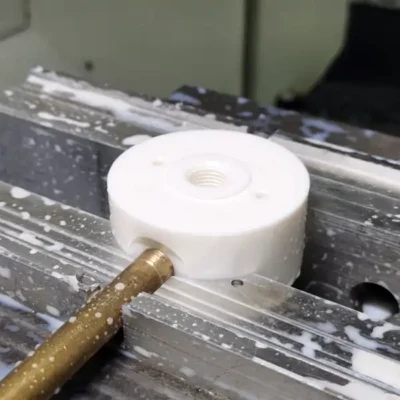
Not every PVDF part suits a mold. For prototypes, low volumes, or large and simple parts, CNC
machining PVDF from rod or plate is faster and needs no tooling, so you skip the mold cost entirely.
Below a few hundred parts, machining is usually the cheaper and quicker route.
Davantech machines PVDF in-house on CNC mills and lathes, holding tolerances down to ±0.025 mm
on critical features, with general dimensions to ISO 2768. PVDF is one of the
CNC materials we run alongside aluminum, stainless, brass
and nylon, part of our CNC machining service. For higher
volumes, injection molding wins on unit
cost, and we will tell you where the crossover falls for your part.
Machined PVDF also suits parts a mold cannot easily make, such as large plates, thick blocks or
one-off fixtures, and it avoids weld lines and molded-in stress, so critical sealing faces stay flat
and true.
What PVDF parts are used for
PVDF turns up wherever a part meets aggressive chemicals, high purity requirements or heat. These are
its main homes.
- Valves and fittings
- Pump parts
- Pipe and couplings
- Tank and duct components
- Ultrapure fluid handling
- Fittings and connectors
- Wafer-handling parts
- Nozzles
- Membrane housings
- Filter components
- Fittings and manifolds
- Sensor bodies
- Insulation parts
- Connectors and seals
- Bearings and bushings
- Outdoor components
If your part sees aggressive chemistry, heat or high-purity requirements and cheaper plastics are
failing, PVDF is usually the answer. Send the drawing and we will confirm the grade and the best way
to make it.
PVDF questions
What is PVDF?
PVDF, polyvinylidene fluoride, is a semi-crystalline fluoropolymer sold under names like Kynar, Solef and Hylar. It combines excellent chemical resistance, service to around 150°C, high purity and a UL 94 V-0 flame rating.
Can PVDF be injection molded?
Yes. PVDF injection molds well at high melt temperatures, around 230 to 290°C, using corrosion-resistant tooling. Davantech supplies injection molded PVDF parts for higher volumes and CNC machined PVDF for prototypes and low runs.
Injection molding or CNC machining for PVDF, which should I choose?
Machine PVDF for prototypes, low volumes and large or simple parts, because there is no tooling cost. Injection mold it for higher volumes, where the unit price drops once the mold is paid for. We do both and will tell you where the crossover falls for your part.
What are the main properties of PVDF?
Excellent chemical resistance to acids, bases and solvents, continuous service to about 150°C, a UL 94 V-0 flame rating, high purity, UV and weather resistance, and very low moisture absorption for dimensional stability.
What is PVDF used for?
Chemical processing (valves, fittings, pumps, pipe), semiconductor ultrapure fluid handling, water treatment, wire and cable insulation, and food or pharma-grade parts where purity and chemical resistance matter.
What tolerances can you hold on machined PVDF?
Typically plus or minus 0.025 mm on critical features, with general dimensions to ISO 2768. Send your drawing and we will confirm what is achievable.
Do you provide material certificates?
Yes. Material certificates are available on request, and we work to an ISO 9001:2015 quality system with inspection before parts ship.