All portfolio projects

Overmolded Strain Reliefs

Custom overmolded strain reliefs in TPE, TPU and silicone, molded directly onto your cable where it leaves a connector, housing or panel. Sealed IP67 and IP68 designs are possible. We make samples, pre-series and series production in our factory in Dongguan, China.

Materials used for overmolding:

  • TPE
  • TPU
  • Silicone

Send us your requirements for overmolded strain reliefs and we will contact you within 24 hours.

Get a quote

Overmolded Strain Reliefs Made for Your Cable

An overmolded strain relief is a flexible TPE, TPU or silicone section injection-molded directly onto a cable where it leaves a connector, housing or panel. Its shape supports the cable at the exit and helps reduce concentrated bending. Cable retention and sealing depend on the jacket, material pairing, geometry and the complete assembly.

Davantech designs and molds custom strain reliefs in our factory in Dongguan, on cables we assemble ourselves or on cables you supply, from samples to series production.

Need a strain relief on your cable?
Send your cable specification, drawing or sample photos. We reply with a DFM review and a quote for the mold and the parts within 24 to 48 hours.

Request a Quote

cable with molded strain relief
Strain relief overmolding at a glance
Materials: TPE, TPU and silicone
Sealing: IP67 or IP68 designs with agreed assembly tests
Cables: Round, flat and multi-core cables, cable splitters
Mold: Designed in-house and with our mold maker; first samples in 35 to 45 days
Quantities: Samples 1 to 10; pre-series from 500 pieces; series quantities quoted per project
Series lead time: 30 to 60 days after sample approval

Strain Relief Designs

The shape of the strain relief follows the cable exit. These are the designs we make most often:

overmolded strain relief at a cable exit

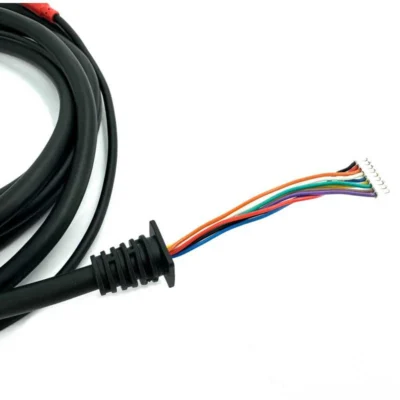
Cable exit strain relief

A tapered sleeve molded onto the cable where it leaves a connector or housing. The taper lets the stiffness fall off gradually, so the cable bends over a radius instead of at one point.

custom overmolded strain relief with panel flange

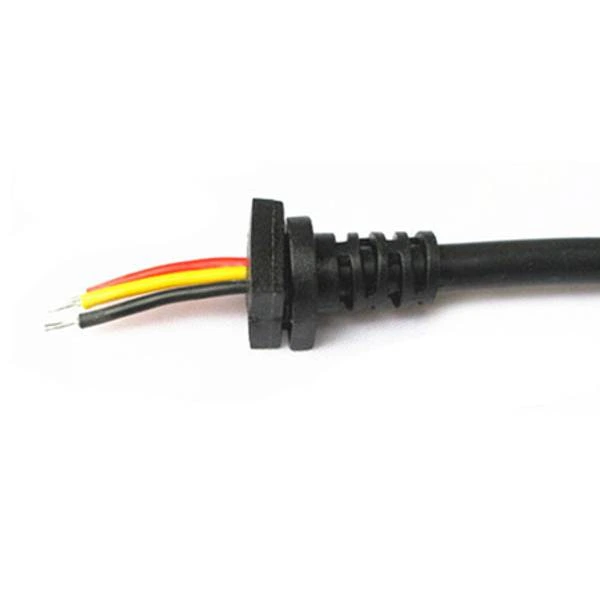
Panel and housing grommet

A strain relief with a molded flange that clamps into a panel or enclosure cut-out. It locates the cable at the panel. Check both the cable-to-overmold joint and the flange-to-panel fit when sealing is required.

TPE strain relief overmolded on a white cable

Ribbed bend relief

A ribbed relief for cable exits on hand-held devices and similar assemblies. Rib spacing, wall section and material hardness influence how it bends; review the profile with the actual cable.

Cables that branch into two or more legs get a molded splitter body instead; see our overmolded cable splitters.

Overmolded Strain Relief vs Other Solutions

Factor Overmolded strain relief Heat-shrink tubing Cable gland Clip-on or glued boot
Protection against bending Profile designed around the cable Depends on tubing and transition May need separate bend relief Depends on boot profile and fit
Cable retention Bond, interlock and connector retention Depends on tubing and adhesive Compression clamp where provided Depends on attachment method
Sealing Verify the finished assembly Adhesive-lined options available Check gland and panel installation Depends on boot and joint design
Appearance Integrated molded profile Sleeved transition Separate hardware Separate fitted part
Tooling Custom mold required No custom mold for standard tubing No custom mold for standard gland Standard or custom-molded boot
Assembly step Mold onto prepared cable Position and shrink Fit and tighten Fit; bond where specified

Compare tooling, assembly work and the required cable support for your quantity. Standard tubing, glands or boots can avoid a custom mold; a custom overmold allows the exit profile to be designed around the cable and installation. Keep any cable clamp or retention feature required by the connector.

TPE, TPU or Silicone

Select the overmold grade with the actual cable jacket, required flexibility and service conditions. A polymer family name alone does not establish adhesion, temperature capability or a finished assembly rating.

Material Why consider it What to check
TPE Soft, flexible cable exits and grip profiles Select a grade for the actual jacket; review hardness, adhesion and exposure.
TPU Cable support where abrasion and mechanical wear matter Check the grade for fluids, moisture and outdoor exposure, and verify the jacket bond.
Silicone Flexible molded reliefs where the design specifies silicone Review the cure process, jacket compatibility, tear resistance and service temperature.

The jacket, compound, preparation and molding conditions all affect the joint. For a material-selection comparison, see TPE vs TPU for overmolding.

TPE strain relief cable overmolding

Designing a Strain Relief That Lasts

  • Match the overmold to the jacket. Check the exact jacket and overmold grades, not only their family names. Surface condition and molding conditions also affect adhesion. Send the cable datasheet if available.
  • Taper the relief. Choose the length, taper or ribs around the cable bend radius, available space and movement. Verify the profile with the complete cable; one length-to-diameter ratio does not suit every design.
  • Keep enough wall thickness. Very thin sections tear and do not grip the cable; we advise on the minimum wall for your cable and material.
  • Round every edge at the cable exit. Avoid an abrupt or sharp transition that concentrates bending or abrades the jacket.
  • Specify the tests. Put the required pull-out force, bend test and IP rating on the drawing, so we can design the mold and the test plan for them.

Inspection and Testing

  • Dimensional and visual inspection of the molded relief against your drawing on every batch.
  • Pull-out test of the cable from the overmold, to the force agreed on the drawing.
  • Sealing verification to the agreed IP test conditions and connector configuration. Production leak screening, if required, is a separate agreed check.
  • Electrical checks of finished cable assemblies to the agreed circuit and acceptance criteria. A continuity check does not establish every aspect of insulation or long-term performance.

First samples are checked and measured before series production starts, and every shipment includes an inspection report. We work under ISO 9001:2015.

How a Strain Relief Project Runs

1. DFM review
We check your cable, drawing or sample and propose the shape, material and test plan.
2. Mold
The mold is designed in-house and with our mold maker. First samples (T1) in 35 to 45 days.
3. Sample approval
You test the samples. We adjust the mold if needed before series production.
4. Series production
Series production in 30 to 60 days, with the same mold, process and inspection every batch.

For the full process from cable to finished assembly, see our step-by-step guide to overmolded cables, or our overmolding services for everything we mold.

Overmolded Strain Relief Questions

What is an overmolded strain relief?
A flexible section molded directly onto a cable where it leaves a connector, housing or panel. Its profile helps reduce concentrated bending at the exit. Cable retention and sealing depend on the materials, geometry and complete assembly.
Is an overmolded strain relief better than heat-shrink tubing?
The choice depends on the cable and installation. A custom overmold allows a dedicated exit profile; standard heat-shrink can avoid custom tooling, and adhesive-lined tubing can provide a sealed joint in suitable applications. Compare the required bend support, retention and sealing on the finished assembly.
Which material is best for a cable strain relief?
Choose the exact material grade for the cable jacket, flexibility and exposure. TPE, TPU and silicone offer different formulation options. Verify adhesion and assembly performance; a family name alone does not establish oil resistance, temperature capability or medical suitability.
How long should a strain relief be?
Set the length and profile from the cable bend radius, movement, material stiffness and available space. There is no single length-to-diameter ratio for every cable. For repeated movement, agree a bend test that represents the application.
Can an overmolded strain relief be waterproof?
A molded cable entry can be designed for IP67 or IP68 requirements. Verify the finished assembly, including the panel or connector interface where applicable. Agree the connector configuration and, for IP68, immersion depth and duration. A production air-leak check alone does not establish an IP rating.
Can you overmold a strain relief on a cable we supply?
Yes. We can mold on cables you supply, or make the complete cable assembly in-house, including cutting, stripping, termination and testing.
How long does it take to get samples?
The mold is designed and built in about 35 to 45 days, including the first samples. Series production follows in 30 to 60 days after sample approval.
What is the minimum order quantity?
Samples start at 1 to 10 pieces, and pre-series starts from 500 pieces. Series quantities are quoted with the tooling. Send the quantity you need so we can review the practical batch size and total cost for your design.
Ready to protect your cables?

Send your cable specification and drawing. We reply within 24 to 48 hours with a DFM review and a quote for the mold and the parts.