
How Much Does CNC
Machining Cost?
Regional hourly rates, per-part cost breakdowns, and the factors that drive CNC machining pricing. Real production data from a working factory, not estimates from a directory.
Understanding CNC Machining Cost
CNC machining cost depends on four things: material, machining time, setup, and finishing. The hourly machine rate varies dramatically by region, with China typically 30 to 60 percent below the USA and Europe for equivalent precision work. This page breaks down each cost component with real numbers from production, not estimates, so you can compare quotes accurately and identify where to save money without compromising quality.
All pricing data on this page is based on Davantech’s production records and verified industry benchmarks. Rates reflect 2025/2026 market conditions.

CNC Machining Hourly Rates by Region
Hourly rates include labour, machine depreciation, and overhead. Material, setup, and finishing are separate line items in any serious quote.
| Process | China | USA | Europe |
|---|---|---|---|
| CNC Milling (3–4 axis) | $25 – $50/hr | $60 – $120/hr | €40 – €100/hr |
| CNC Turning (lathe) | $20 – $40/hr | $50 – $100/hr | €35 – €80/hr |
| 5-Axis / Swiss-type | $50 – $90/hr | $120 – $300/hr | €100 – €150/hr |
Note: these are typical shop rates. Actual per-part cost depends on cycle time, batch size, material, and finishing requirements. Request a quote with your drawing for an exact price.
CNC Milling vs CNC Turning Cost
Milling and turning are different processes with different cost profiles. Understanding which one your part needs, or whether it needs both, is the first step to an accurate cost estimate.
- Ideal for Housings, brackets, covers, enclosures
- Axes 3-axis, 4-axis, 5-axis
- Tolerance ±0.02 – 0.05 mm standard
- China cost / part (aluminium) $35 – $55
- USA cost / part $80 – $150
- Europe cost / part €60 – €120
- Ideal for Shafts, bushings, spacers, connectors
- Types Conventional, Swiss-type, live tooling
- Tolerance ±0.01 – 0.03 mm standard
- China cost / part (stainless) $20 – $35
- USA cost / part $50 – $90
- Europe cost / part €40 – €70
Turning is generally 20 – 30% cheaper than milling because it requires fewer setups and shorter cycle times. Many parts need both operations. Davantech plans milling and turning together at DFM stage to minimise setups.
The 4 Components of CNC Machining Cost
Every CNC machined part includes the same four cost categories. Understanding them helps you read quotes, compare suppliers, and find savings.
Cost Breakdown: Aluminum Bracket
A CNC-milled aluminium 6061 bracket, 100-piece batch, sandblast + anodise finish. This is a real production example showing how the same part costs nearly three times less when produced in China.

| Cost Element | China | USA | Europe |
|---|---|---|---|
| Material | $1.50 | $2.00 | €2.00 |
| Setup (÷ 100 pcs) | $0.30/pc | $0.80/pc | €0.60/pc |
| Machining (0.5 hr) | $20/pc | $60/pc | €45/pc |
| Finishing + QC | $3/pc | $8/pc | €6/pc |
| Total per Part | ≈ $25 | ≈ $70 | ≈ €55 |
Methodology: costs are based on Davantech production data for a standard aluminium 6061-T6 bracket, 80 × 60 × 25 mm, 3-axis milling, 100-piece batch, sandblast + Type II anodise. Western rates are industry benchmarks from published sources. Actual costs vary by geometry, tolerance, and volume.
Cost Examples Machined Parts
CNC Machining Cost Examples in China
Below are real examples based on Davantech’s production data.
Example 1: Aluminum 6061 Small Enclosure
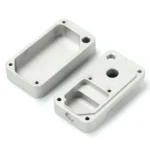
- Size: 70 × 35 × 25 mm
- Process: 3-axis milling
- Qty: 200 pcs
- Price in China: $4.10/pc
- Typical USA price: $9–12/pc
Example 2: Stainless Steel 304 Coupling
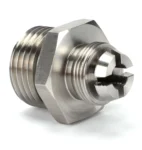
- Process: Turning + threading
- Qty: 500 pcs
- Price in China: $1.90/pc
- Typical Europe price: €4–6/pc
Example 3: PA6 Plastic Mounting Block

- Process: Milling
- Qty: 1000 pcs
- Price in China: $3.5/pc
- Typical Europe price: €7–10/pc
Summary:
| Part | Qty | China Price | Western Price |
| Aluminum bracket | 200 pcs | $4.10 | $9–12 |
| Stainless shaft | 500 pcs | $1.90 | €4–6 |
| POM cover | 1000 pcs | $3.5 | €7-10 |
When Higher-Cost Regions Still Make Sense
China offers the best pricing for most CNC work, but local production in the USA or Europe is sometimes the right call. Here's when:
-
Same-day prototypesWhen you need parts in 24 – 48 hours for a design review or test, shipping from China adds 3 – 5 days even by air. A local shop wins on speed for urgent one-offs.
-
Aerospace or medical certificationIf your customer requires AS9100, ITAR, or FDA-registered manufacturing with full domestic traceability, you may need a certified local facility.
-
Tariff-sensitive projectsIf import duties push the landed cost above domestic pricing, local production may be cheaper after all. Always compare landed cost, not factory cost.
-
Strict IP controlFor defence or highly sensitive IP, some companies require domestic-only manufacturing as a policy requirement regardless of cost.
7 Ways to Reduce CNC Machining Cost
These are the changes that save the most money in real production. Every tip comes from DFM reviews we do daily at Davantech.

-
Increase internal corner radiiMatch radii to standard cutter sizes (R3, R4, R5 mm). Tight corners force smaller tools with slower feed rates and more passes, which doubles or triples cycle time on deep pockets.
-
Reduce the number of setupsDesign features accessible from as few orientations as possible. Every additional setup adds 15 – 45 minutes of non-cutting time plus a positional error risk between faces.
-
Unify hole sizes and thread typesEvery unique hole size requires a tool change. If you have 6 different hole sizes, consolidate to 2 or 3 where function allows. Same with thread types (M3, M4, M5).
-
Specify tolerances only where neededBlanket ±0.02 mm on every dimension forces the machinist to slow down everywhere. Apply tight tolerances only on mating surfaces and functional interfaces. Let non-critical features default to ISO 2768-m.
-
Avoid thin walls and deep pocketsWalls below 1.0 mm (metal) or 1.5 mm (plastic) require slow feeds and light cuts to prevent chatter and deflection. Deep pockets with depth > 4× width have the same problem. Keep wall thickness ≥ 1.5 mm where possible.
-
Increase batch sizeSetup cost is fixed. On a 10-piece order the setup cost per part is 10× higher than on a 100-piece order. If you expect repeat orders, consider ordering a larger first batch to bring the unit cost down.
-
Specify finishing only where neededAnodising, plating, and polishing add cost. If only the visible face needs a cosmetic finish, specify it by surface rather than applying it to the entire part. Functional surfaces often need only a machined or sandblasted finish.
Davantech provides a free DFM review with every quotation. We flag cost-saving opportunities before you commit to production. Read our design guidelines for machined parts for more detail.
CNC Machining Cost Questions
What is the average cost of CNC machining in China?
The average hourly rate for CNC machining in China is $25 – $50 for milling and $20 – $40 for turning. 5-axis and Swiss-type work runs $50 – $90/hr. These rates include labour, machine depreciation, and factory overhead but exclude material, setup, and finishing. Per-part cost depends on cycle time, batch size, and complexity. For a typical aluminium milled bracket, expect $20 – $55 per part in China versus $60 – $150 in the USA.
Why is CNC machining cheaper in China than in the USA or Europe?
Three factors: lower labour cost (machinist wages in Dongguan are roughly 1/5th of US equivalents), lower overhead (factory rent, utilities, insurance), and a deeper local supply chain for raw materials, tooling, and surface treatment. The machines themselves are often identical (Fanuc, Mazak, Haas), so the precision capability is the same. The cost difference is in the operating cost per hour, not the technology.
Does lower cost mean lower quality?
Not if you choose the right factory. Cost is driven by labour rates and overhead, not by quality standards. An ISO 9001:2015 certified factory in China with CMM inspection, documented processes, and English-speaking engineering delivers the same dimensional accuracy as a Western shop at a lower hourly rate. The key is qualification: check the ISO certificate scope, ask for inspection reports from previous orders, and run a first-article inspection on your first batch. Read our CNC machining China guide for a full qualification checklist.
What is the biggest cost driver in CNC machining?
Machining time. The formula is simple: hourly rate × cycle time = machining cost per part. Everything that increases cycle time increases cost: tight tolerances, deep pockets, small radii, multiple setups, exotic materials that require slower feeds. Material cost is usually the smallest component unless you're machining titanium or PEEK.
How do I reduce CNC machining cost without changing my design?
Increase batch size (setup cost is amortised over more parts), consolidate orders (run multiple part numbers in the same shipment), and choose a factory in a lower-cost region. Beyond that, small design tweaks have a large impact: increasing corner radii, reducing the number of unique hole sizes, and applying tight tolerances only where functionally needed. Davantech provides a free DFM review with every quote that flags these opportunities.
How long does CNC machining take in China?
Prototype lead time is typically 5 – 7 working days from order confirmation. Production runs of 100 – 1,000 pieces take 2 – 4 weeks depending on complexity and finishing. Shipping by air freight adds 3 – 5 days door to door; sea freight adds 25 – 35 days to Europe. Davantech handles export documentation and offers DDP, FOB, and EXW Incoterms.
How can I get a quote for CNC machining?
Send a 3D CAD file (STEP or IGES) and a 2D production drawing (PDF) with tolerances, GD&T, and surface finish callouts. Specify the material, quantity, and any surface treatment. Davantech returns a detailed quote with cost breakdown and free DFM review within 24 hours. Submit your drawing here.
Get Your CNC Machining Cost in Seconds
Upload you 3D file and 2D drawings to our CNC machining cost calculator. We return a reviewed and detailed quote in 24 hours with material cost, machining cost, setup, finishing, and lead time broken out line by line. Free DFM review included.