
CNC Milling Services
3-axis and 4-axis milling of metals and engineering plastics. Billet, castings, forgings, and extrusions. Tolerances to 0.02 mm. Parts up to 1,800 mm long. Free DFM review with every quotation.
±0.02
MM TOLERANCE
60+
CNC MACHINES
1800
MM MAX. LENGTH
ISO
9001:2015 CERTIFIED
What is CNC Milling?
CNC milling is a subtractive manufacturing process in which a computer-controlled rotating cutting tool removes material from a solid workpiece to produce a finished part. The cutting tool moves along multiple axes simultaneously, guided by a digital program generated directly from your 3D CAD file.
CNC milling is the correct machining process for prismatic parts with non-rotational geometry: enclosures, housings, brackets, manifolds, plates, heat sinks, and any part with pockets, slots, contours, or complex curved surfaces.
The starting workpiece does not have to be a solid piece of material. CNC milling is frequently applied as a secondary operation on castings, forgings, and extrusions to machine critical surfaces, precision holes, threads, and toleranced features that the primary process cannot achieve. In these cases, tooling cost applies for the casting die, forging die, or extrusion die, but the milling operation itself requires no additional tooling investment.
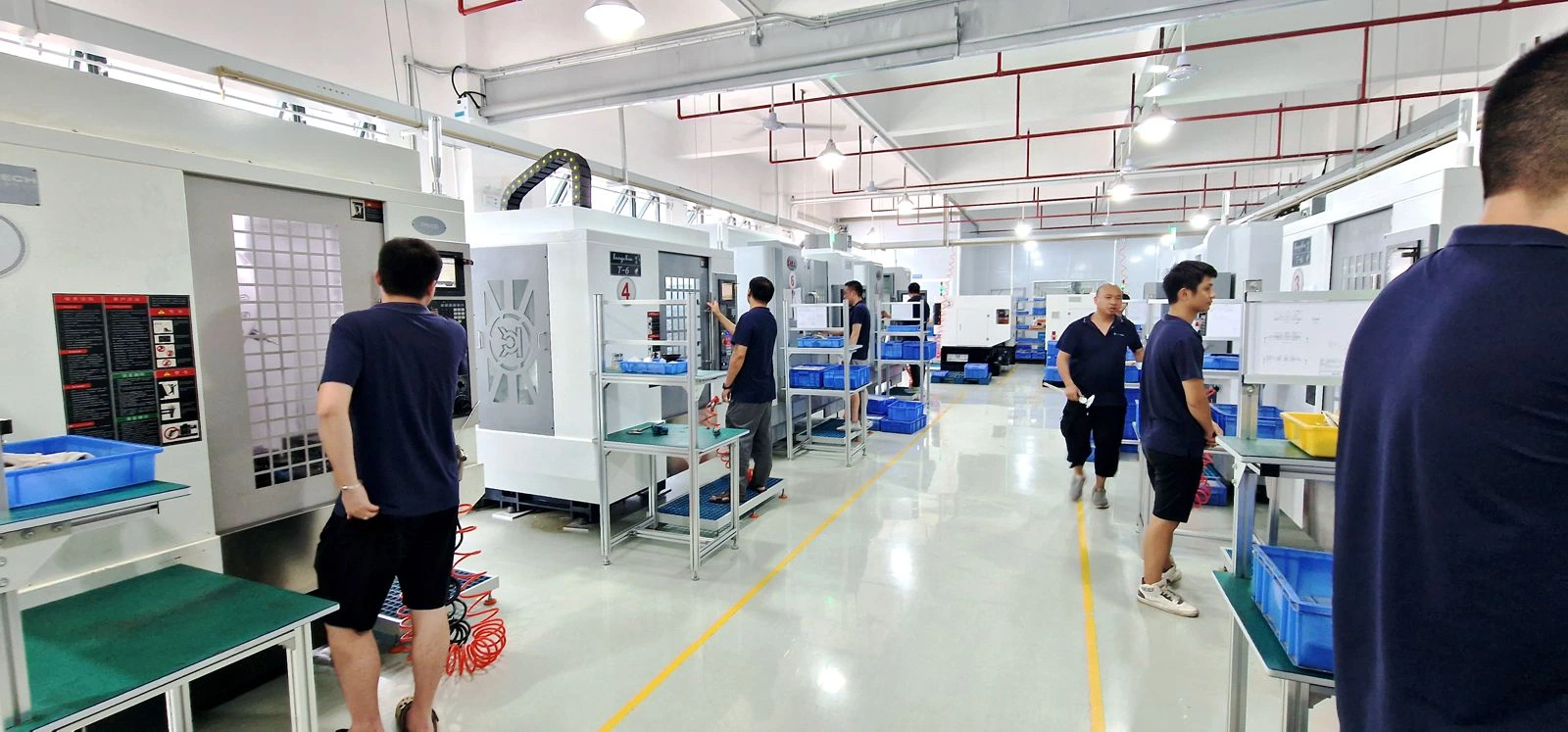
At Davantech, CNC milling is one of our primary services. Our facility in Dongguan operates more than 60 CNC machining centres including 3-axis and 4-axis configurations, plus one dedicated large-format machine for parts up to 1,800 mm long. Every milled part is supported by a free DFM review and full inspection documentation under our ISO 9001:2015 quality management system.

Milling From a Block of Material
Parts produced directly from your STEP file. No mold or die investment. Ideal for prototypes, low volumes, and complex geometries that injection molding cannot produce.
Simple prismatic parts through complex multi-face components, all on the same site. 4-axis milling reduces re-fixturing and the tolerance stack-up that comes with multiple setups.
Standard milling tolerance is plus or minus 0.05 mm. Precision features to plus or minus 0.02 mm achievable on critical dimensions. Confirm at quotation stage.
Aluminium alloys, stainless steel, brass, copper, titanium, and a full range of engineering plastics including PEEK, POM, Nylon, and Polycarbonate.
Anodizing, powder coating, passivation, nickel plating, and more managed under the same ISO quality system. One shipment, one inspection report.
Our engineers review every drawing for wall thickness, tool access, tolerance feasibility, and finishing compatibility before production starts.
Machining Capabilities
3-AXIS and 4-AXIS MILLING
The number of axes determines which part geometries can be produced and how many setups are required. Davantech operates both 3-axis and 4-axis configurations. The correct choice depends on your part geometry, required tolerances, and production volume.
3-AXIS MILLING
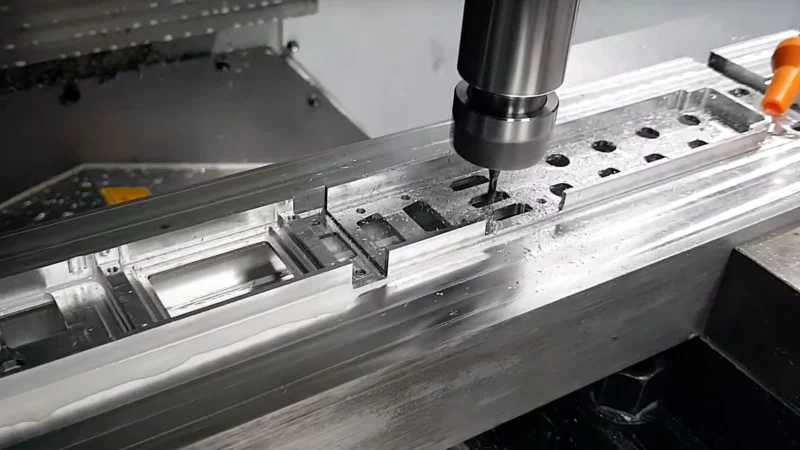
The cutting tool, also called a mill, moves along X, Y, and Z axes while the workpiece remains stationary. This covers the majority of prismatic parts and is the most cost-effective option for straightforward geometries. Suitable for billet parts as well as secondary milling on castings, forgings, and extrusions.
- Pockets, slots, and step features
- Drilled and tapped hole patterns
- Flat and profiled surfaces
- Enclosures, housings, and brackets
- Secondary ops on castings and forgings
Envelope: 800 x 600 x 500 mm · Tolerance: ±0.05 mm standard / ±0.02 mm precision
4-AXIS MILLING
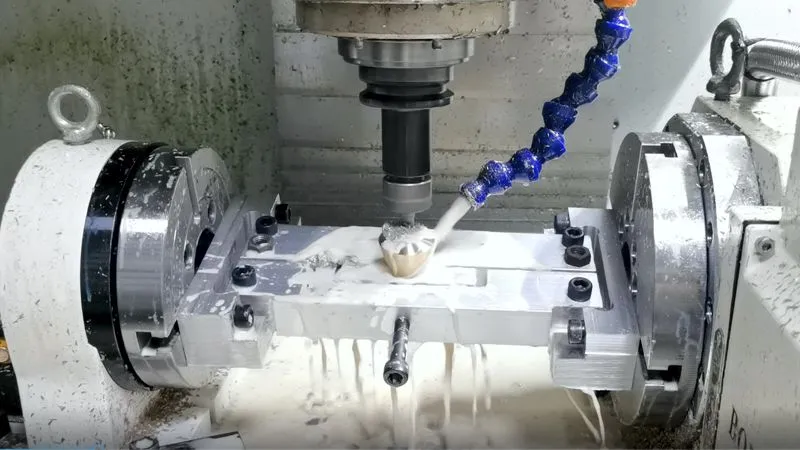
A rotary axis (A-axis) is added, allowing the workpiece to rotate. The cutting tool can access features on the side of the part without re-fixturing, reducing setup time and improving positional accuracy between features on different faces. Also applicable to secondary milling on cylindrical castings and extrusions.
- Features on multiple faces in one setup
- Helical grooves and spiral features
- Cam profiles and eccentric features
- Shaft and cylinder side features
- Secondary ops on cylindrical forgings and extrusions
Rotary axis: 360° continuous · Cylindrical parts with side features, multi-face parts
Milling of Castings, Forgings And Extrusions
CNC milling from a solid block is not the only starting point. A large proportion of production milling work involves secondary machining of parts produced by a primary near-net-shape process. In these cases, tooling cost applies for the primary process but milling itself requires no additional tooling investment.

Milling of Castings
Die castings and sand castings produce complex 3D shapes at high volume and low unit cost, but their dimensional accuracy and surface quality are limited by the casting process itself. CNC milling is applied after casting to machine critical mating surfaces, precision bores, thread holes, and any feature requiring a tolerance tighter than the casting process can achieve. Typical materials: aluminium A380, A356; zinc ZA-8; and iron castings for industrial parts.
Milling of Forgings
Forged parts offer the highest mechanical strength of any process, but the forging dies produce only the rough shape. CNC milling provides the precision geometry: flat mounting faces, precision holes, threads, and toleranced bearing surfaces. Common in automotive, aerospace, and heavy industrial applications where a combination of maximum strength and dimensional accuracy is required. Materials: AL6061, 7075; steel 4140, 4340; titanium Ti-6Al-4V.
Milling of Extrusions
Aluminium and other metal extrusions produce profiles with a constant cross-section at low cost. CNC milling adds features that extrusion cannot: end-face machining, cross-holes, pockets, slots at non-standard locations, and any feature that varies along the length of the profile. Heat sink extrusions, structural frame sections, LED housing profiles, and rail and track components are commonly finished this way. The extrusion die is the tooling cost; milling is set-up based.
Tooling Cost Considerations
When we use CNC milling on a casting, forging, or extrusion, the tooling cost must be factored into the total part cost. Die casting tooling typically ranges from a few thousand to tens of thousands of dollars depending on complexity. Forging dies and extrusion dies carry their own costs. For low volumes, milling from solid block avoids tooling cost. For high volumes, the combination of molds plus precision milling produces the most cost-effective result.
Technical Specifications
Tolerances And Specifications
Reference tolerances for CNC milling at Davantech. Tighter tolerances are achievable on specific critical features. All untoleranced dimensions default to ISO 2768-m unless your drawing specifies otherwise. Confirm critical tolerances at quotation stage.
| Feature / Operation | Standard | Achievable |
|---|---|---|
| CNC Milling | ||
| Linear dimension | ±0.05 mm | ±0.02 mm |
| Flatness | 0.05 mm | 0.02 mm |
| Positional accuracy (holes) | ±0.05 mm | ±0.02 mm |
| Parallelism / squareness | 0.05 mm | 0.02 mm |
| Min wall thickness (metal) | 0.8 mm | 0.5 mm |
| Min wall thickness (plastic) | 1.0 mm | 0.8 mm |
| Min feature size | 1 mm | 0.8 mm |
| Surface roughness Ra | 1.6 µm | 0.8 µm |
| General Capability | ||
| Standard envelope | 800 x 600 x 500 mm | |
| Large-format envelope | Up to 1,800 mm length | |
| Prototype lead time | 3 to 5 business days | |
| Production lead time | 5 to 10 business days | |
| Minimum order quantity | 1 piece | |
Milling vs Turning — When to Choose
Choose CNC Milling When
Your part has non-rotational geometry: flat faces, pockets, slots, or complex 3D surfaces. Any part that cannot be described primarily as a cylinder or cone is a milling job. Enclosures, housings, brackets, manifolds, and plates are all typical milling parts.
Choose CNC Turning When
Your part has a primary axis of symmetry: shafts, bushings, fittings, nozzles, and connectors. Turned parts are produced faster and at lower cost than equivalent milled parts when the geometry is primarily rotational.
When Both Are Used
Many parts combine both operations. A shaft may be turned to diameter then milled to add a keyway or flat. A manifold may be milled for its external geometry then turned for precision bore features. Davantech plans both operations together at DFM stage.
50+ Machinable Materials
We stock and machine a broad range of metals and engineering plastics. Specialist alloys and polymers sourced on request. contact us with your material specification.
ALUMINUM ALLOYS
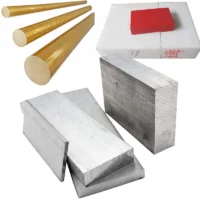
- 6061-T6 (general purpose)
- 7075-T6 (high strength)
- 2024-T3 (fatigue resistance)
- 5052-H32 (marine grade)
- 6063 (anodizing grade)
BRASS & COPPER
- Brass CW614N (free-cutting)
- Brass C360 (UNS)
- Phosphor Bronze C510
- Copper C110 / C101
- Aluminium Bronze C630
STEEL & STAINLESS
- Stainless 303 (free-machining)
- Stainless 304 / 304L
- Stainless 316 / 316L
- Carbon Steel 1018 / 1045
- Alloy Steel 4140 / 4340
SPECIALTY METALS
- Titanium Grade 2 (pure)
- Titanium Grade 5 (Ti-6Al-4V)
- Inconel 625 / 718
- Hastelloy C276
- Kovar / Invar alloys
ENGINEERING PLASTICS
- PEEK (high performance)
- Acetal / Delrin (POM)
- Nylon PA6 / PA66
- Polycarbonate (PC)
- PTFE (Teflon
MORE PLASTICS
- UHMWPE
- ABS (general purpose)
- PPS (high temperature)
- PVDF (chemical resistant)
- Garolite G10 / FR4
CNC Milling Operations
A reference guide to the most common milling operations Davantech performs. Most parts require several of these operations in combination, planned together at DFM stage to minimise setups.

Face and Peripheral Milling
Removing material across the full width of a flat surface (face milling) or along the perimeter of a workpiece (peripheral milling). Produces the flat reference surfaces and overall external geometry of a part. Standard starting operation on most prismatic parts.
Pocket and Slot Milling
Producing enclosed cavities (pockets) and open-sided channels (slots) of defined depth and width. Used for component recesses, cable routing channels, snap-fit features, and any internal geometry that must be machined rather than molded.
Contour and Profile Milling
Machining curved or irregular external and internal profiles by driving the cutter along a programmed path. Produces shaped housings, ergonomic surfaces, cam profiles, and any geometry that cannot be produced by straight-line cutting alone.
Drilling, Tapping, and Reaming
Hole-making operations performed on the same machining center as the milling operations, eliminating re-fixturing. Drilling produces through and blind holes. Tapping cuts internal threads from M1.6 to M64. Reaming improves hole accuracy and surface finish beyond what drilling alone can achieve.
Built-In Quality
Every part verified against your drawing before shipment. Our ISO 9001:2015 QMS governs every step from incoming material to outgoing inspection.
Design For Manufacturability
Every quotation at Davantech includes a free DFM review by our engineering team. We check your drawing for potential production issues before committing to a price, so problems are identified at zero cost rather than during machining.

Wall thickness
Thin walls below 0.8 mm risk deflection during machining and vibration-induced chatter. We flag these before production and propose solutions.
Tool access and depth-to-diameter ratio
Deep narrow pockets require long reach tooling which reduces stiffness and increases tolerance risk. We identify these and propose modified depths or radii where needed.
Tolerance feasibility
Tolerances tighter than the process capability of the machine and material combination are flagged. We confirm what is achievable and at what cost before production starts.
Surface treatment compatibility
Anodizing and plating add material thickness. We check that critical toleranced features remain within spec after the specified treatment.
Frequently Asked Questions
Common questions about CNC milling services at Davantech, answered by our engineering team.
What is CNC milling?
CNC milling is a subtractive manufacturing process in which a computer-controlled rotating cutting tool removes material from a solid workpiece to produce a finished part. The cutting tool moves along multiple axes simultaneously, controlled by a digital program generated directly from a 3D CAD file. CNC milling produces prismatic parts, pockets, slots, contours, and complex 3D surfaces in metals and engineering plastics to tight dimensional tolerances. Unlike casting or injection molding, CNC milling requires no tooling investment when starting from billet, making it ideal for prototypes, low volumes, and parts with frequent design changes.
What is the difference between 3-axis and 4-axis CNC milling?
In 3-axis milling the cutting tool moves along the X, Y, and Z axes while the workpiece remains stationary. This covers the majority of prismatic parts including pockets, slots, holes, and flat surfaces. In 4-axis milling a rotary axis is added, allowing the workpiece to rotate so the tool can access features on the side of the part in a single setup, reducing re-fixturing and improving positional accuracy between features on different faces. Davantech operates 3-axis and 4-axis milling centres.
What tolerances can Davantech achieve on CNC milled parts?
Standard CNC milling tolerance at Davantech is ±0.05 mm on linear dimensions for general machining, and ±0.02 mm for precision features. Flatness to 0.02 mm and positional accuracy to ±0.02 mm are achievable on critical features. All untoleranced dimensions default to ISO 2768-m unless otherwise specified on the drawing. Confirm critical tolerances at quotation stage.
What materials can Davantech CNC mill?
Davantech mills a broad range of metals and engineering plastics including aluminium alloys (6061-T6, 7075-T6, 2024-T3, 5052, 6063), brass (CW614N, C360), copper (C110), stainless steel (303, 304, 316L), carbon and alloy steels (1018, 1045, 4140), titanium (Grade 2 and Ti-6Al-4V), PEEK, POM (Delrin/Acetal), Nylon (PA6/PA66), Polycarbonate, PTFE, ABS, and PMMA. For full material properties and grade selection guidance see our materials for CNC machining guide.
Can Davantech CNC mill castings, forgings, and extrusions?
Yes. CNC milling is frequently applied as a secondary operation on castings, forgings, and extrusions to machine critical surfaces, precision bores, threads, and toleranced features that the primary process cannot achieve. In these cases, tooling cost applies for the casting die, forging die, or extrusion die, but the milling operation itself requires no additional tooling investment. Davantech reviews the most economical process route at DFM stage for every new project.
What is the maximum part size for CNC milling at Davantech?
The standard milling envelope at Davantech is 800 × 600 × 500 mm. For larger parts up to 1,800 mm in length, a dedicated large-format milling machine is available. Contact us with your part dimensions and we will confirm the appropriate machine and any fixturing requirements.
When should I choose CNC milling over CNC turning?
CNC milling is the correct process for prismatic parts with non-rotational geometry, including enclosures, housings, brackets, manifolds, plates, and any part with pockets, slots, or flat surfaces. CNC turning is better suited to cylindrical parts such as shafts, bushings, and fittings. Many parts require both operations. Davantech plans turning and milling together at DFM stage to minimise setups and reduce lead time.
Does Davantech offer surface finishing and treatment for CNC milled parts?
Yes. Surface finishing and treatment are available in the same order as CNC milling. Finishing options include sandblasting, brushing, polishing, and grinding. Treatment options include anodizing (Type II and Type III hard anodizing), powder coating, electroless nickel plating, passivation, black oxide, and PVD coating. All treatments are managed under Davantech's ISO 9001:2015 quality system and documented in the order inspection report.