
High Quality Turning Services
Conventional and sliding headstock turning of metals and engineering plastics. Max diameter 200 mm, length 500 mm. Tolerances to 0.02 mm. Free DFM review with every quotation.

±0.02
MM TOLERANCE
200
MM MAX. DIAMETER
500
MM MAX. LENGTH
ISO
9001:2015 CERTIFIED
What is CNC TURNING?
CNC turning is a subtractive manufacturing process in which the workpiece rotates at high speed while a stationary cutting tool removes material to produce a cylindrical or rotational part. The process is controlled by a computer program generated directly from a 3D CAD file.
CNC turning (also called lathing) is the correct CNC machining process for any part whose primary geometry is defined by rotation around a central axis: shafts, bushings, fittings, nozzles, pins, bolts, connectors, and spindles. For these shapes, turning is faster, more accurate, and more cost-effective than milling or any other process.
Davantech operates both conventional CNC lathes and sliding headstock (Swiss-type) turning centres. Conventional turning covers parts up to 200 mm diameter and 500 mm long. Swiss-type turning handles long slender parts with a length-to-diameter ratio greater than 4:1, where the guide bushing supports the workpiece close to the cutting zone and prevents deflection. Every turned part is backed by a free DFM review and full inspection documentation under our ISO 9001:2015 quality management system.

Turning From a Bar of Material
Standard CNC lathes for parts up to 200 mm diameter. Sliding headstock turning for long slender parts where conventional chucking would cause deflection and inaccuracy.
Standard turning tolerance is plus or minus 0.05 mm. Precision diameters and bores to plus or minus 0.02 mm achievable on critical features. Confirm at quotation stage.
Straight turning, facing, taper turning, grooving, threading, boring, and knurling all performed on the same machine, eliminating re-fixturing between operations.
Parts requiring both rotational and prismatic features are planned at DFM stage. Turned to diameter on the lathe, then transferred to a milling centre for keyways, flats, cross-holes, and pockets.
Aluminium alloys, brass, copper, stainless steel, steel, titanium, and a full range of engineering plastics including PEEK, POM, Nylon, and PTFE.
Anodizing, powder coating, passivation, nickel plating, and more managed under the same ISO quality system. One shipment, one inspection report.
Our engineers review every drawing for wall thickness, tool access, tolerance feasibility, and finishing compatibility before production starts.
Machining Capabilities
Conventional and Swiss-Type Turning
The correct turning method depends on your part geometry, length-to-diameter ratio, and required tolerances. Davantech operates both types. Many orders use both, conventional turning for larger-diameter features, Swiss-type for long precision sections of the same part family.

CONVENTIONAL CNC TURNING
The workpiece is held in a clamp and rotates while the cutting tool moves along X and Z axes to produce the required geometry. Suited to manufacture parts with larger diameters and moderate length-to-diameter ratios. The standard choice for shafts, bushings, fittings, and general rotational components.
- Shafts, spindles, and axles
- Bushings, sleeves, and spacers
- Fittings, nozzles, and connectors
- Threaded components (external and internal)
- Flanges and discs
- General rotational components from bar or billet
Max diameter: 200 mm · Max length: 500 mm · Tolerance: ±0.05 mm standard / ±0.02 mm precision

SWISS-TYPE (Sliding Headstock) TURNING
The bar stock feeds axially through a guide bushing, which supports the workpiece very close to the cutting zone. This eliminates the deflection that would occur in conventional turning when a long slender part is held only at the chuck end. We use Swiss turning for parts with a length-to-diameter ratio greater than 4:1, and for small-diameter precision components.
- Long slender shafts and pins
- Small precision contact pins and probes
- Medical device components and cannulas
- Watch and instrument parts
- High-volume small turned parts from bar stock
- Parts requiring simultaneous front and back operations
Best for: L/D ratio above 4:1 · Small precision diameters · High-volume small parts
Technical Specifications
Tolerances And Specifications
Reference tolerances for CNC turning at Davantech. Tighter tolerances are achievable on specific critical features. All untoleranced dimensions default to ISO 2768-m unless your drawing specifies otherwise. Confirm critical tolerances at quotation stage.
| Feature / Operation | Standard | Achievable |
|---|---|---|
| CNC Turning | ||
| Diametral dimension | ±0.05 mm | ±0.02 mm |
| Linear dimension | ±0.05 mm | ±0.02 mm |
| Roundness (circularity) | 0.03 mm | 0.01 mm |
| Cylindricity | 0.05 mm | 0.02 mm |
| Concentricity / runout | 0.05 mm | 0.02 mm |
| Surface roughness Ra | 1.6 µm | 0.8 µm |
| Thread tolerance class | 6g / 6H | 5g / 5H |
| General Capability | ||
| Max diameter (conventional) | 200 mm | |
| Max length (conventional) | 500 mm | |
| Min diameter (Swiss-type) | From 0.5 mm | |
| Prototype lead time | 3 to 5 business days | |
| Production lead time | 5 to 10 business days | |
| Minimum order quantity | 1 piece | |
Turning vs Milling – When to Choose
Choose CNC Turning When
Your part has a primary axis of symmetry: shafts, bushings, fittings, nozzles, connectors, and pins. Any part described primarily as a cylinder, tube, or cone is a turning job. Turning produces these shapes faster, more accurately, and at lower cost than milling.
Choose CNC Milling When
Your part has non-rotational geometry: flat faces, pockets, slots, or complex 3D surfaces. Enclosures, housings, brackets, and manifolds are milling jobs regardless of whether they contain some cylindrical features.
When Both Are Used
Many parts need both. A shaft turned to diameter then milled for a keyway or flat. A housing milled for its external shape then bored on the lathe for a precision bore. Davantech plans both operations together at DFM stage to minimise setups and total lead time.
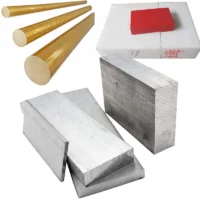
50+ CNC Turning Materials
Davantech turns a broad range of metals and engineering plastics. For a full breakdown of material properties, grades, machinability, and surface treatment compatibility see our materials for CNC machining guide.
ALUMINUM ALLOYS
- 6061-T6 (general purpose)
- 7075-T6 (high strength)
- 2024-T3 (fatigue resistance)
- 5052-H32 (marine grade)
- 6063 (anodizing grade)
BRASS & COPPER
- Brass CW614N (free-cutting)
- Brass C360 (UNS)
- Phosphor Bronze C510
- Copper C110 / C101
- Aluminium Bronze C630
STEEL & STAINLESS
- Stainless 303 (free-machining)
- Stainless 304 / 304L
- Stainless 316 / 316L
- Carbon Steel 1018 / 1045
- Alloy Steel 4140 / 4340
SPECIALTY METALS
- Titanium Grade 2 (pure)
- Titanium Grade 5 (Ti-6Al-4V)
- Inconel 625 / 718
- Hastelloy C276
- Kovar / Invar alloys
ENGINEERING PLASTICS
- PEEK (high performance)
- Acetal / Delrin (POM)
- Nylon PA6 / PA66
- Polycarbonate (PC)
- PTFE (Teflon
MORE PLASTICS
- UHMWPE
- ABS (general purpose)
- PPS (high temperature)
- PVDF (chemical resistant)
- Garolite G10 / FR4
What CNC Lathing Can Produce
A reference guide to the turning operations Davantech performs. Most parts combine several of these in a single setup, planned at DFM stage to minimise cycle time and handling.
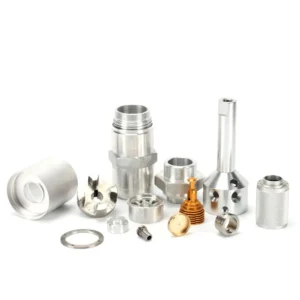
Straight Turning
Reducing the diameter of the workpiece along its length to produce a cylindrical surface of defined diameter and length. The fundamental turning operation. Produces shafts, pins, and the cylindrical body of most turned parts. Roughing passes remove the bulk of material; finishing passes achieve the final diameter and surface finish.
Facing
Machining a flat end face perpendicular to the rotational axis of the part. Used to establish a square reference surface at the end of the workpiece, to clean up a parted-off face, or to machine a shoulder face to a precise axial length. Facing is performed at the start of most turning jobs to establish a datum surface.
Taper Turning
Producing a conical surface by moving the tool at an angle to the rotational axis. Used for tapered shafts, Morse taper tooling, valve seats, and any part requiring a gradual change in diameter along its length. Taper angle and form are controlled by the CNC program and verified dimensionally at first article inspection.
Threading
Cutting helical thread forms on external and internal cylindrical surfaces. External threads are cut with a single-point threading tool; internal threads are cut with a boring bar or tapping tool. Metric (M), UNC, UNF, BSP, BSPT, and NPT thread forms are all produced. Thread pitch, class of fit, and start/end undercuts are verified against the drawing before release.
Grooving and Parting
Grooving cuts circumferential channels of defined width and depth into the diameter of a part — used for O-ring seats, snap ring grooves, undercuts for thread relief, and oil retention grooves. Parting cuts through the workpiece to separate a finished part from the remaining bar stock. Both operations use plunge-style tools and are planned to avoid vibration and chatter on slender workpieces.
Boring and Knurling
Boring enlarges and finishes a pre-drilled internal bore to a precise diameter and surface finish — used for bearing housings, press-fit bores, and any internal feature requiring closer tolerance than drilling alone can achieve. Knurling impresses a regular textured pattern onto the outer surface of a part using hardened rollers, producing a grip surface for hand-tightened fasteners, press-fit sleeves, and tool handles.
Built-In Quality
Every part verified against your drawing before shipment. Our ISO 9001:2015 QMS governs every step from incoming material to outgoing inspection.
Design For Manufacturability
Every quotation at Davantech includes a free DFM review by our engineering team. We check your drawing for potential production issues before committing to a price, so problems are identified at zero cost rather than during machining.

Length-to-diameter ratio
Parts with L/D above 4:1 risk deflection and chatter in conventional turning. We flag these and recommend Swiss-type turning or a steady rest where needed.
Undercuts and thread relief
Threads running to a shoulder without a relief groove cannot be cut cleanly. We check thread geometry and recommend relief dimensions at DFM stage.
Tolerance feasibility
Tolerances tighter than the process capability for the material and diameter are flagged. We confirm what is achievable and at what cost before production starts.
Surface treatment compatibility
Anodizing and plating add material thickness. We check that critical toleranced diameters and bores remain within spec after the specified treatment.
Frequently Asked Questions
Common questions about CNC turning and lathing services at Davantech, answered by our engineering team.
What is CNC turning?
CNC turning, also called CNC lathing, is a subtractive manufacturing process in which the workpiece rotates at high speed while a stationary cutting tool removes material to produce a cylindrical or rotational part. The process is controlled by a computer program generated directly from a 3D CAD file. CNC turning produces shafts, bushings, fittings, nozzles, pins, and any part whose primary geometry is defined by rotation around a central axis. It is the most efficient process for cylindrical parts, producing tight diametral tolerances and excellent surface finishes at high speed.
What is the difference between CNC turning and CNC lathing?
CNC turning and CNC lathing refer to the same process. Both terms describe the operation of a CNC lathe, where the workpiece rotates and a cutting tool removes material to produce a cylindrical part. CNC turning is the more common term in modern manufacturing; CNC lathing or lathe machining is used interchangeably and means the same thing.
What is the difference between conventional CNC turning and Swiss-type turning?
In conventional CNC turning the workpiece is held in a chuck and rotates while the cutting tool moves along X and Z axes. It is suited to parts with larger diameters and moderate lengths. In Swiss-type (sliding headstock) turning the bar stock feeds axially through a guide bushing, supporting the workpiece very close to the cutting zone. This eliminates deflection, enabling long slender parts to be turned to tight tolerances that conventional turning cannot achieve. Swiss turning is preferred for parts with a length-to-diameter ratio greater than 4:1 and for small precision components from bar stock.
What tolerances can Davantech achieve on CNC turned parts?
Standard CNC turning tolerance at Davantech is ±0.05 mm on linear and diametral dimensions for general machining, and ±0.02 mm for precision features. Roundness to 0.01 mm and surface roughness Ra of 0.8 µm are achievable on precision turning operations. All untoleranced dimensions default to ISO 2768-m unless otherwise specified on the drawing. Confirm critical tolerances at quotation stage.
What materials can Davantech CNC turn?
Davantech turns a broad range of metals and engineering plastics including aluminium alloys (6061-T6, 7075-T6, 2024-T3), brass (CW614N, C360), copper (C110, C145 tellurium copper), stainless steel (303, 304, 316L), carbon and alloy steels (1018, 1045, 4140), titanium (Grade 2 and Ti-6Al-4V), PEEK, POM (Delrin/Acetal), Nylon (PA6/PA66), Polycarbonate, PTFE, and ABS. For full material properties and grade selection guidance see our materials for CNC machining guide.
What is the maximum part size for CNC turning at Davantech?
The maximum turning envelope at Davantech is 200 mm diameter and 500 mm length for conventional CNC turning. For long slender parts, Swiss-type sliding headstock turning is available and handles parts from 0.5 mm diameter with very high length-to-diameter ratios. Contact us with your part dimensions and we will confirm the appropriate machine and fixturing.
When should I choose CNC turning over CNC milling?
CNC turning is the correct process for cylindrical and rotational parts such as shafts, bushings, fittings, nozzles, pins, and connectors. CNC milling is better suited to prismatic parts with flat faces, pockets, slots, and non-rotational geometry such as enclosures, housings, and brackets. Many parts require both operations. Davantech plans turning and milling together at DFM stage to minimise setups and reduce lead time.
What turning operations does Davantech perform?
Davantech performs a full range of turning operations including straight turning (reducing diameter along the length), facing (producing a flat end face perpendicular to the axis), taper turning (producing conical surfaces), grooving and parting (cutting circumferential grooves or separating finished parts from bar stock), threading (internal and external, metric and imperial), boring (enlarging and finishing internal bores), and knurling (producing a textured grip pattern on the surface).
Does Davantech offer surface finishing and treatment for CNC turned parts?
Yes. Surface finishing and treatment are available in the same order as CNC turning. Finishing options include polishing, burnishing, and grinding. Treatment options include anodizing (Type II and Type III), electroless nickel plating, passivation, black oxide, and zinc plating. All treatments are managed under Davantech's ISO 9001:2015 quality system and documented in the order inspection report.