
POM / Acetal (Delrin) Machining Guide
POM (polyoxymethylene), sold as acetal or under the Delrin brand, is one of the most machinable engineering plastics and a default choice for precision gears, bushings, bearings and low-friction wear parts. It combines high stiffness, excellent dimensional stability and very low moisture absorption, which is exactly why it holds tight tolerances on a lathe or mill. This guide covers the two grades, the properties that matter on the shop floor, how POM compares with other plastics we machine, and the design points that keep parts in tolerance after cutting. Davantech machines POM to print as part of our CNC machining services; see the full list of CNC materials for alternatives.
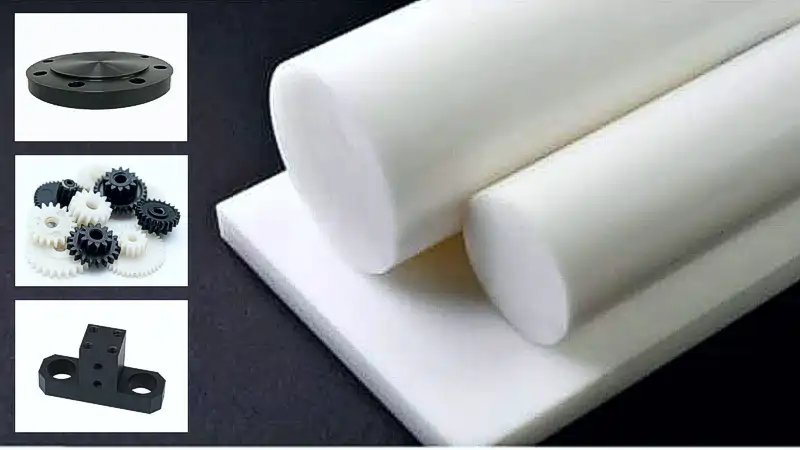
POM key properties
Typical values for machining-grade acetal. Use them for material selection, not as certified design minimums;
exact figures depend on grade and supplier, and we provide mill or material certificates on request.
| Property | Typical value | What it means for your part |
|---|---|---|
| Density | 1.41 g/cm³ | Heavier than nylon or PP; lighter than PTFE |
| Tensile strength | 60–70 MPa | Strong and stiff for an unfilled plastic |
| Moisture absorption | ~0.2% | Parts stay dimensionally stable in humid or wet use |
| Coeff. of thermal expansion | ~110 µm/m·K | High; allow for growth on large or close-fit parts |
| Max continuous service temp | ~100 °C | Short excursions higher; not for hot-water or steam |
| Coeff. of friction | 0.2–0.35 | Low, self-lubricating; ideal for gears and bushings |
| Chemical resistance | Good | Resists fuels, solvents; attacked by strong acids |
| UV resistance | Poor | Use UV-stabilised (black) grade for outdoor parts |
Note: POM is flammable and gives off formaldehyde if overheated, so keep tooling sharp and cutting temperatures down. It cannot be solvent-bonded easily; design for mechanical fasteners or assembly instead of gluing.
Homopolymer vs copolymer
Delrin (homopolymer) is slightly stronger and stiffer and takes a finer finish, which suits small precision gears
and high-load bushings. Copolymer acetal resists hot water and strong chemicals better and has no risk of the
centreline porosity that can appear in thick homopolymer sections. For most parts either works; the decision is
driven by section thickness, chemical exposure and load.
| Grade | Strength & stiffness | Chemical / hot-water resistance | Thick-section porosity |
|---|---|---|---|
| Homopolymer (Delrin) | Highest | Good | Possible centreline porosity |
| Copolymer | Very good | Better | None |
POM vs other plastics we machine
How acetal compares with the other engineering plastics in our material range, so you can choose the right one before you send a drawing.
| Property | POM / Acetal | PA66 Nylon | PVDF | ABS |
|---|---|---|---|---|
| Moisture absorption | ~0.2% | High (to ~8%) | <0.04% | 0.3–0.9% |
| Max service temp | ~100 °C | ~100–120 °C | ~150 °C | ~80 °C |
| Wear / friction | Excellent | Good | Moderate | Poor |
| Chemical resistance | Good | Moderate | Excellent | Moderate |
| Machinability | Excellent | Good (gummy) | Good | Good |
| Relative cost | Low–mid | Low–mid | High | Low |
Related guides: Machining PA66 / nylon · PVDF · all CNC materials
Machining characteristics
-
Machines like brassPOM cuts cleanly with sharp tools at high speed, breaks chips well and takes a fine finish without coolant, so it is fast and cheap to machine to tight tolerances.
-
Watch thermal expansionIts expansion coefficient is roughly ten times that of steel. On large or close-fit parts, cutting heat and ambient temperature shift dimensions, so we let parts stabilise before final measurement.
-
Internal stress can move partsExtruded stock carries internal stress. Removing a lot of material unevenly can warp thin parts; rough-then-finish passes, and annealing where needed, keep them flat and true.
-
Excellent thread and gear detailAcetal holds fine threads, small module gear teeth and crisp edges, which is why it is a first choice for precision motion parts.
Typical applications
- Spur, helical and worm gears
- Bushings and plain bearings
- Cams, rollers and guides
- Manifolds and fittings
- Valve components
- Pump parts
- Insulators and housings
- Snap-fit and clip parts
- Wear pads and slides
POM machining questions
Is Delrin the same as POM or acetal?
What tolerance can you hold on POM parts?
Should I choose POM or nylon (PA66)?
Can POM be used outdoors?
Can POM parts be glued or welded?